
Author: Suzanne Olszewski Chisum
Just as the Statue of Liberty welcomes immigrants with the words from Emma Lazarus’s poem The New
Colossus—“Give me your tired, your poor, / Your huddled masses yearning to breathe free” (Lazarus,
1883)—the St. Louis Gateway Arch stands as a monument to “the territorial expansion of the United
States, and of the hardy pioneers who shaped the history and development of the Western Frontier”
(U.S. Congress, 1935).
Throughout its history, St. Louis has welcomed hundreds of thousands of immigrants. As these
newcomers established homes in the city, they brought with them rich cultural traditions, with their
churches often serving as the center of immigrant life.
Churches were not only places of worship but also centers for social gatherings, education, athletics, and
numerous community activities. They provided immigrants with a sense of belonging while helping
preserve their languages, customs, and cultural identities.
St. Louis has experienced three distinct eras of immigration: the Historic Wave (1840–1920), dominated
by German and Irish immigrants; the Late Twentieth-Century Refugee Wave (1990s), marked by the
arrival of Bosnian refugees; and the Modern Growth Wave (2000s–2020s), characterized by increasing
Latino and Asian immigration.
The City of St. Louis experienced its greatest period of growth during the Historic Wave (1840–1920),
when foreign-born residents comprised nearly 20 percent of the city’s population. Many of the churches
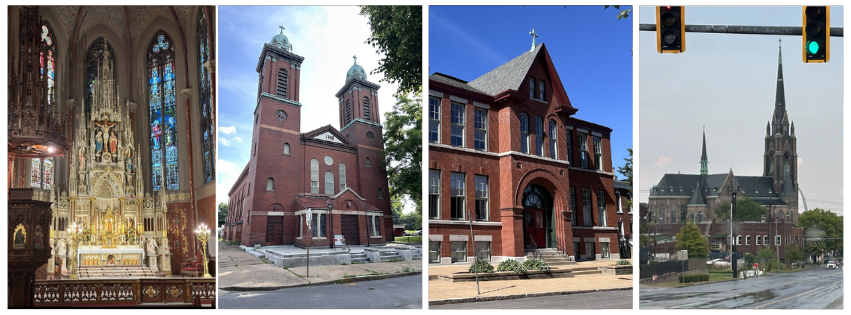
highlighted in the Story of Us Social Media Campaign were either built or planned during this period of
rapid expansion and cultural transformation (City of St. Louis, n.d.).
References
Lazarus, Emma. “The New Colossus,” 1883. Inscription carving. Statue of Liberty, New York, NY.
City of St. Louis. Part I: Peopling St. Louis. City of St. Louis, Department of Planning and Urban Design
Agency, Cultural Resources Office. Accessed June 15, 2026.
https://www.stlouis-mo.gov/government/departments/planning/cultural-resources/preservation-plan/P
art-I-Peopling-St-Louis.cfm
U.S. Congress. 1935. Historic Sites Act of 1935. Public Law 74-292. U.S. Statutes at Large 49:666
The Story of Us is a part of By the People: Conversations Beyond 250, a series of community-driven programs created by humanities councils in collaboration with local partners. The initiative was developed by the Federation of State Humanities Councils and the Smithsonian Center for Folklife and Cultural Heritage.
To learn more of what we’re doing with The Story of US, visit mohumanities.org/signature-series